EU Social Partners for fisheries warn: New Mediterranean fishing proposal threatens thousands of jobs and entire coastal communities

The European Social Partners in Fisheries express their deep concern and strong opposition to the European Commission’s proposal for Mediterranean fishing opportunities for 2026. The measures, representing some of the most severe cuts ever imposed, risk dismantling an entire sector already pushed to its limits, putting at stake thousands of jobs, family livelihoods and the socio-economic fabric of coastal communities across the region.
The proposal foresees drastic reductions in fishing effort:
- Up to –65% fewer fishing days for trawlers in France and Spain
- –64% in Italy
- A baseline of 9.6 days per vessel per year, if no compensatory measures are applied
- Strong new restrictions on hake longliners
- Limits on deep-water shrimp catches
- Additional restrictive fishing calendars in key areas
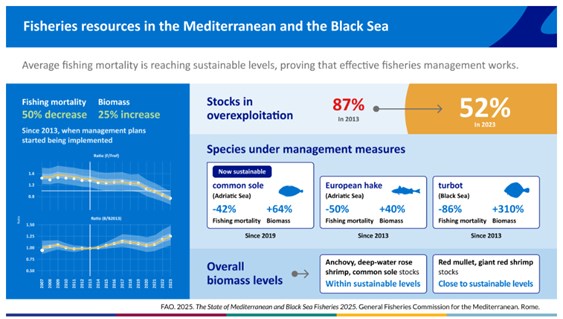
These cuts come despite the already significant sacrifices made by fishers to rebuild stocks. These efforts have been acknowledged in the FAO–GFCM’s State of the Mediterranean and Black Sea Fisheries (2025)[1], which notes significant improvements and fish populations increase in several stocks.
Yet, instead of consolidating this progress through balanced, predictable, and socially just measures, the Commission proposes a package that the sector widely considers economically unsustainable. Even with the Commission’s proposed compensation scheme to recover fishing days through additional conservation measures, the impact in regions such as Catalonia, the Western Mediterranean, and the Strait of Sicily, would be severe and disproportionate. According to the social partners, the proposed package is not in line with the latest scientific advice[2].
Despite constantly being referred to as the model to follow, the European Commission’s proposal lacks a genuinely holistic approach. Other relevant environmental stressors – such as such rising temperature of waters and water acidification - and human activities that impact fish stocks are disregarded, and the blame seems to fall exclusively on fishers.
Fundamental Questions for the Commission
Given the gravity of the situation, the European Social Partners request clear answers from the European Commission:
- Have the measures drafted for 2026 been accompanied by a socioeconomic study assessing their potential impacts on workers and businesses, and how to address them?
- How can the EU, in a phase where competitiveness and food sovereignty are declared priorities, continue disregarding the future of Mediterranean fishers?
Fishers provide fresh, local protein and contribute to Europe’s maritime economy and strategic food autonomy. These proposals undermine that mission. - Why did the Commission not propose changes, knowing that this scenario would repeat itself? If no other proposal was possible because of the multiannual plan, why did the Commission not put forward the necessary changes in advance? For the second consecutive year, fishing vessel owners and fishers face an identical crisis without structural solutions.
- Are compensatory measures truly feasible across all regions?
While the proposal allows the recovery of some days through selective gear or new closures, this is not possible everywhere. What will happen to the sector in those regions?
Fishers warn that these reductions amount to an invitation to push companies and workers out of the sector, accelerating a process already visible in many coastal areas where young people are leaving the profession and communities are losing their economic base.
Call for an Immediate Change of Course
The European Social Partners urge the Commission and EU Fisheries Ministers, who will negotiate the final package on 11–12 December, to adopt a balanced, realistic and socially sustainable approach.
We call for:
- Measures that protect both marine resources and the right of coastal communities to sustain their livelihoods;
- A framework that ensures predictability, regional viability, and fair treatment for all fleets;
- A sufficient allocation of fishing days to safeguard economic viability, with 180 days per year as baseline reference;
- The removal of catch limits for deep-water red shrimp;
- Meaningful dialogue with social partners and fishers on the ground, whose knowledge and sacrifices must be recognized and respected.
Social Partners concluded: ‘Fishers have done and are doing their part: modernising fleets, innovative and adaptive fishing methods and complying with strict closures and reductions. Now it is time for the EU to fulfill its responsibility: protecting the women and men who feed Europe, and preserving the communities that depend on the sea. It is an SOS call for the Mediterranean fisheries sector.’
ANNEX - GFCM Infographic on the Mediterranean, November 2025
Press Contact:
Daniel Voces, Europêche Managing Director (+32 489 26 81 07 / daniel.voces@europeche.org)
Andrea Albertazzi, ETF Fisheries Policy Officer (+32 470 93 05 89 / a.albertazzi@etf-europe.org)
Riccardo Pelani, Copa-Cogeca Policy Advisor on Aquaculture and Fisheries (riccardo.pelani@copa-cogeca.eu; +32 478189915)
[1] https://www.fao.org/gfcm/publications/somfi/state-of-the-mediterranean-and-black-sea-fisheries-2025
[2] https://stecf.ec.europa.eu/meetings-calendar/meetings-past-future/ewg-25-11-fishing-effort-regime-demersal-fisheries-west-med-2025-10-06_en
Sources: Europeche
Attachments:
Tags: Mediterranean